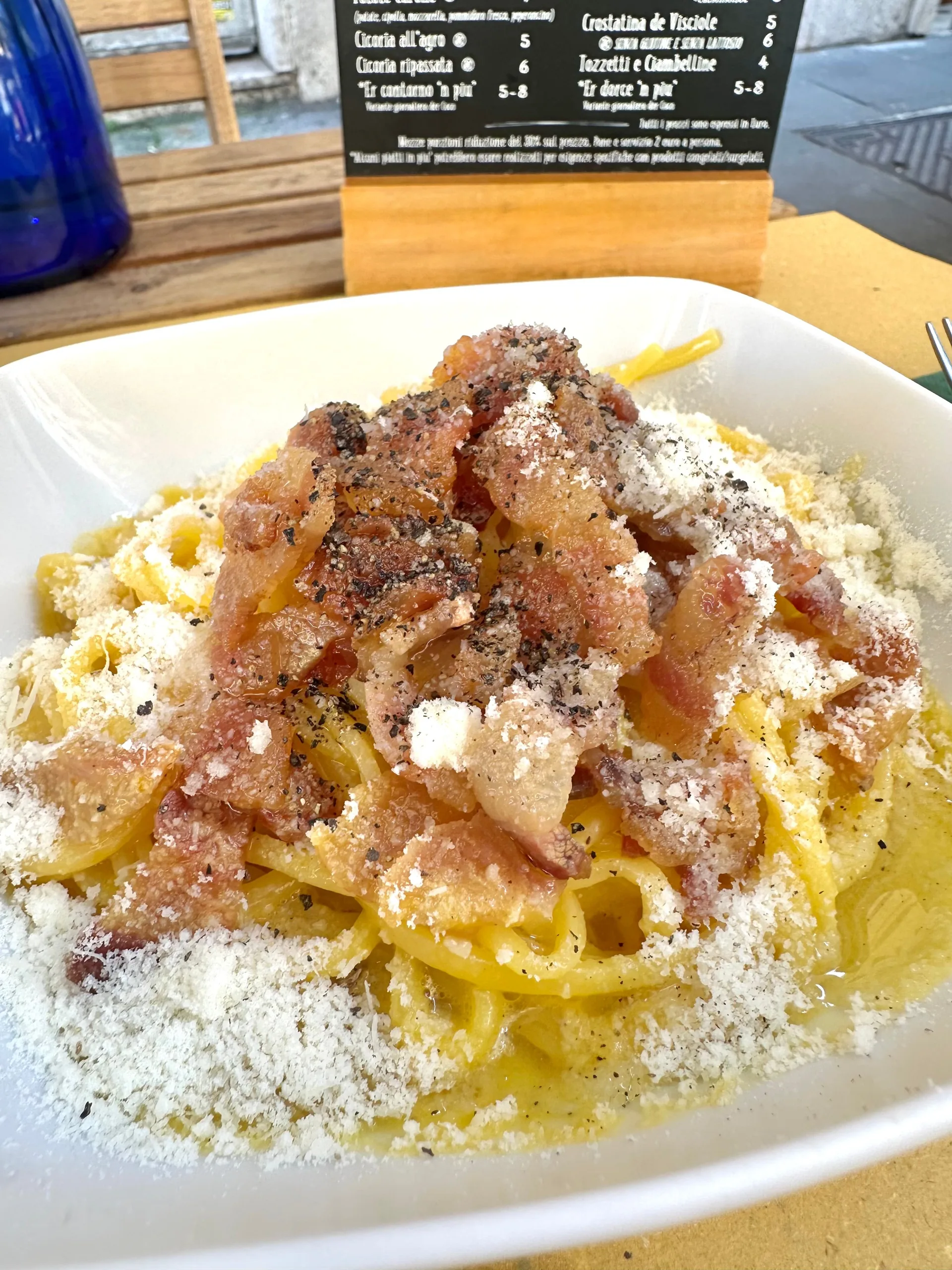
Popis
Král římských prvních chodů: těstoviny, vejce, křupavé guanciale a pecorino. Krémový mýtus, který musíte ochutnat.
Původ jídla
Řím
Původní název
Carbonara
Ingredience tradičního receptu
Těstoviny - Vepřové bříško - Slepičí vejce - Pepř - Pecorino
Zakázané ingredience
Smetana - Česnek - Cibule - Olivový olej - Máslo
Použití těchto ingrediencí je považováno za nepřijatelnou chybu všemi milovníky tohoto pokrmu.
Možné alergeny
Gluten - Vejce
Způsob stravování / Předpisy
VšežravéHaramTaref
Disciplinář
---
Průvodce Foodoso nejlepšími místy na degustaci carbonara
Často kladené otázky
Origins - Where does carbonara come from?
Pasta alla carbonara is one of the most famous dishes in Italian cuisine, but its origin is controversial and several theories have been advanced.
The most well-known theory is that it was born in Rome around the middle of the 20th century, created by charcoal workers who transported coal to the city.
According to this theory, the charcoal workers prepared this dish with the ingredients they had available, such as guanciale, pecorino romano and eggs. Guanciale was an economical ingredient and easy to find, while pecorino romano was a cheese typical of the Lazio region. Eggs were a precious ingredient, but the charcoal workers used them sparingly, beating the yolks with pecorino and black pepper and adding them to the pasta only at the end of cooking.
This theory is supported by a 1952 document, in which pasta alla carbonara is mentioned as a typical dish of Roman cuisine. However, some critics have argued that this document is not sufficient to prove the Roman origin of carbonara, since it could simply have been inspired by a similar dish that already existed.
Another highly credited hypothesis, perhaps the most well-known, is that carbonara was born during the time of the Allied occupation of Rome during World War II. American soldiers, with their rations of powdered eggs and bacon, would have inspired this recipe.
According to this theory, American soldiers would have combined powdered eggs, bacon and pecorino romano to create a dish similar to carbonara. This theory is supported by the fact that carbonara is a relatively simple dish that can be prepared with easily available ingredients.
There are also those who argue that carbonara is actually of Neapolitan origin, and that it only arrived in Rome later. According to this theory, pasta alla sfoglia would have been prepared with eggs, cheese and guanciale, and would have been brought to Rome by Neapolitans during their migration to the capital.
There is also the hypothesis of an even earlier origin, dating back to the 18th century and the cuisine of Papal Rome, where eggs, cheese and guanciale were often used in combination.
According to this theory, carbonara would have been born as a variant of "pasta alla gricia", a traditional dish of Lazio cuisine prepared with guanciale, pecorino romano and black pepper.
In short, there are various ideas about the birth of carbonara. But whatever its origin, today this dish has become one of the most beloved symbols of Italian cuisine in the world and in particular of the city of Rome, which has made it the quintessential iconic dish of the city.
Jaké jsou ingredience původního receptu?
Klasické ingredience pro přípravu těstovin alla carbonara jsou:
Těstoviny
Vajíčka
Pecorino romano
Guanciale
Pepr
Hrubá sůl
Pro těstoviny alla carbonara se tradičně používají tyto tvary těstovin:
Spaghetti nebo Spaghettoni: je to nejikoničtější formát a ten, se kterým carbonara pravděpodobně vznikla. Dlouhé a tenké spaghetti se dokonale hodí ke krémové omáčce.
Mezze maniche: mezze maniche rýhované nebo hladké jsou platnou alternativou ke spaghetti, vhodnou pro zachycení omáčky.
Rigatoni: rigatoni jsou nejlepší volbou ze krátkých těstovin díky svému tvaru, který omáčku zachytí.
Samozřejmě lze carbonaru připravit i s jinými tvary těstovin, ale ty tradiční zůstávají tyto. V římských restauracích není vzácností ani použití Tonnarella, lazijské verze spaghetti alla chitarra, čerstvých vajíčkových těstovin, které však puristé carbonary nemají v oblibě kvůli přebytku vajíčka v pokrmu.
Také ohledně sýra je třeba uvést několik upřesnění. Za prvé, někteří kuchaři a některé recepty doporučují použít směs pecorino romano a parmigiano reggiano, aby se zmírnila slanost pecorino. Za druhé je třeba věnovat pozornost druhu pecorino romano, který by měl mít alespoň 12 měsíců zrání, přičemž minimum dle disciplinare je 8 měsíců, a upřednostňovat pecorino získané z ne příliš velkých forem.
Jaké jsou kroky přípravy Carbonary?
Tradiční recept na těstoviny alla Carbonara spočívá v orestování, neboli zpocení, guanciale na pánvi po několik minut, nejprve na mírném a poté na silném ohni, přičemž se nechá zkaramelizovat smažením ve vlastním tuku.
Dalším krokem přípravy je rozmíchání vajíček s nastrouhaným pecorinem a špetkou pepře v misce. Lidová moudrost ohledně počtu vajíček říká: celé vejce plus žloutek na osobu plus jedno pro pánev.
Mezitím se těstoviny vaří v osolené vodě, přičemž je důležité přivést osolenou vodu k varu, než se do ní těstoviny vloží.
Jakmile jsou těstoviny scezeny velmi al dente, přesypou se do pánve s guanciale.
Rozmíchaná vejce se poté nalijí do pánve a smíchají s těstovinami s rozpuštěným sýrem a guanciale, přičemž se rychle míchá pro provázání celé směsi, přísně při vypnutém ohni, aby se zabránilo efektu vaječné omelety, a pomalu se přidává voda z vaření, pokud je to třeba pro krémovost pokrmu.
Je důležité, aby těstoviny byly dobře horké, aby krém z vajíček zhoustl, aniž by se uvařil.
Pokrm se podává okamžitě, dokončený čerstvě mletým pepřem a nastrouhaným pecorinem navrchu.
Jakých chyb je třeba se vyvarovat při přípravě Carbonary?
Seznam chyb a hrůz páchaných při přípravě těstovin alla Carbonara je pravděpodobně nekonečný, zejména pokud se podíváme i za hranice Itálie, ale tyto jsou rozhodně nejčastější – bohužel i na italské půdě:
Převaření těstovin. Musí se scezovat velmi al dente, téměř syrové, aby se dokončily vaření mísením s omáčkou. Převařené těstoviny jsou jedním z nejčastějších problémů u neitalských kuchařů, kteří navíc často vhazují těstoviny do vody, která ještě nevře.
Použití pancetty nebo slaniny místo guanciale. Guanciale dodává pokrmu velkou část jeho charakteristické chuti a přestože jde také o vepřové maso, nelze ho srovnávat s jinými tučnými kousky podobného vzhledu.
Přidávání smetany, cibule nebo jiných netradičních ingrediencí. Přestože je v mnoha zemích použití smetany v receptu rozšířenější a výrazně usnadňuje dosažení krémového efektu, smetana zcela mění, a dokonce převrací chuť pokrmu.
Nesolení vody na vaření těstovin. Voda musí být dobře osolená, aby těstoviny získaly chuť.
Vynechání pepře. Černý pepř dodává charakteristickou pikantní dochuť.
Dosažení příliš vysokých teplot. Vaječná směs nesmí nikdy dosáhnout bodu varu, jinak místo krémové omáčky budeme mít v talíři kousky míchaných vajec.
Jaké víno se hodí k porci Carbonara?
Carbonara je fantastické těstovinové jídlo, ale rozhodně není snadné, když jde o výběr vína jako doplňku. Všechny ingredience mají totiž výrazné chutě: těstoviny s jemnou chutí, guanciale s olejnatou a obemykající konzistencí, pecorino s výraznou chutí a pepř s pálivými tóny.
Aby se zdůraznila tato exploze vůní a textur, vyžaduje párování víno schopné vyvážit všechny různé nuance. Především výrazná svěžest a kyselost, aby se ústa očistila od mastného pocitu guanciale. Dále dobrá struktura a intenzita, aby vydržela silné aroma pecorino. A konečně příjemná alkoholická hebkost, aby zmírnila přímočarost pepře.
Tradice vyžaduje bílé víno ze střední Itálie, aby připomnělo oblast původu pokrmu. Skvělými volbami by tedy mohla být bílá vína jako Frascati, Greco di Tufo, Trebbiano d'Abruzzo, Pinot Grigio a Vermentino. Alternativně lze sáhnout po živých abruzzských rosé. Naopak je třeba se vyhnout příliš plným nebo taninickým červeným vínům.
Are there any variants of Carbonara?
In Rome, it is possible to find some variants of Carbonara that essentially consist of adding an ingredient to the traditional recipe, mainly truffle, but also mushrooms.
There are then a series of other dishes for which the term carbonara is commonly used, but which actually have very little in common other than the use of egg in the dish.
Among these are carbonara di mare or carbonara di pesce, carbonara di zucchine, carbonara di asparagi, carbonara di carciofi, carbonara vegetariana or carbonara vegana.
How is carbonara prepared around the world?
Being arguably the most widespread pasta dish in the world, it's important to be aware that in many countries the recipes used are very different from the original, having adapted to local tastes and ingredients.
For example, in the United States it is frequently prepared with cream, grated cheese and pancetta or bacon instead of guanciale. It often also contains garlic, onion or other ingredients that are atypical for the Italian recipe.
In Great Britain and Ireland too, there is a tendency to use bacon and add cream or whole egg to the beaten eggs. In these versions carbonara turns out to be particularly creamy.
In France it is known as "carbonara alla francese", made with fresh cream, white wine and Parmigiano. Guanciale is absent and it is decidedly more delicate.
Carbonara in South America is seasoned with pork or chicken meat instead of guanciale. It is often enriched with tomato, peppers and other vegetables.
In Asian cuisines, ingredients such as soy sprouts, wok vegetables or shrimp are commonly added to carbonara.
In Japan, the version with zucchini, peas and shiitake mushrooms is popular and very often it is prepared completely without using eggs.
Each country has interpreted pasta alla carbonara in an original way, but taking considerable liberties with respect to the traditional Italian recipe. It is important to keep these differences in mind both for the tourist visiting Italy, who will probably experience a flavor different from what was expected, and for restaurateurs who might plan a more gradual approach to offer based on the actual knowledge of the dish.
Is there a world day for of Carbonara?
Of course. For years now, April 6th has been celebrated worldwide as Carbonara Day with special initiatives and the collaboration of thousands of restaurants that offer dedicated menus or promotions on the purchase of a Carbonara dish.
In which city can you eat the best carbonara in the world?
This is the hundred-million-dollar question and it probably doesn't even have a single definitive answer. What we can say for certain is that Rome and Lazio are the right places where you can find the strongest candidates for the final victory.
We, in our own small way, make an effort to taste them for you, in complete anonymity, to photograph them and review them without filters or bias. We hope the result of our work will be useful for you to enjoy excellent carbonara and perhaps avoid the so-called tourist trap restaurants.