Árak Róma városban
Átlagos ár
14 EUR
Legolcsóbb
9 EUR
Legdrágább
25 EUR
Leírás
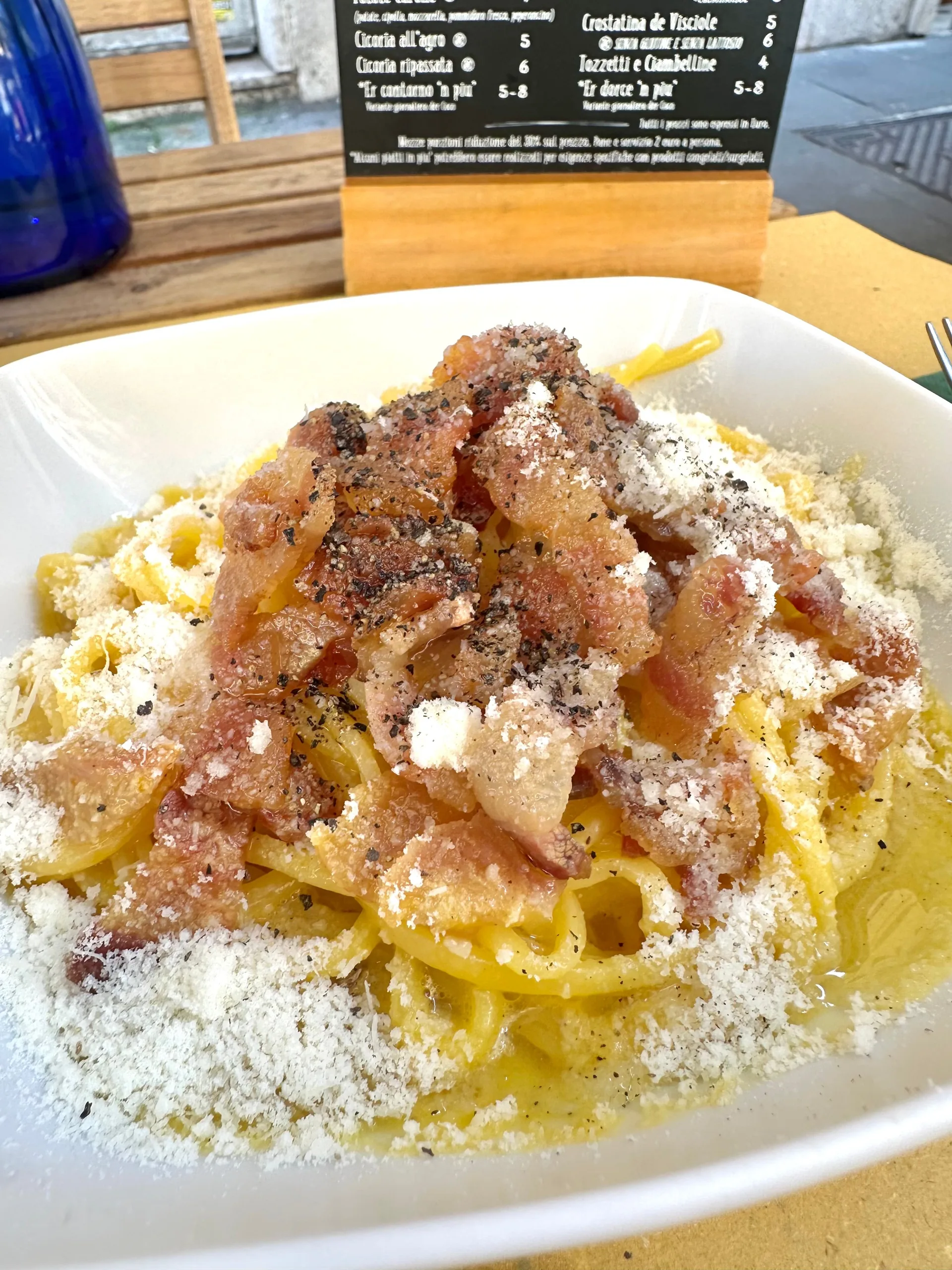
A római első fogások királya: tészta, tojás, ropogós guanciale és pecorino. Egy krémes mítosz, amelyet feltétlenül ki kell próbálni.
Az étel eredete
Róma
Eredeti név
Carbonara
A hagyományos recept összetevői
Tészta - Guanciale - Tyúktojások - Bors - Pecorino
Tiltott összetevők
Tejszín - Fokhagyma - Hagyma - Olívaolaj - Vaj
Ezen összetevők használata az étel összes szerelmese számára elfogadhatatlan hibának tekinthető.
Lehetséges allergének
Glutén - Tojások
Étkezési stílus / Előírások
MindenevőHaramTaref
Szabályzat
---
A Foodoso útmutatói a legjobb helyekhez carbonara evéséhez
Gyakran Ismételt Kérdések
Origins - Where does carbonara come from?
Pasta alla carbonara is one of the most famous dishes in Italian cuisine, but its origin is controversial and several theories have been advanced.
The most well-known theory is that it was born in Rome around the middle of the 20th century, created by charcoal workers who transported coal to the city.
According to this theory, the charcoal workers prepared this dish with the ingredients they had available, such as guanciale, pecorino romano and eggs. Guanciale was an economical ingredient and easy to find, while pecorino romano was a cheese typical of the Lazio region. Eggs were a precious ingredient, but the charcoal workers used them sparingly, beating the yolks with pecorino and black pepper and adding them to the pasta only at the end of cooking.
This theory is supported by a 1952 document, in which pasta alla carbonara is mentioned as a typical dish of Roman cuisine. However, some critics have argued that this document is not sufficient to prove the Roman origin of carbonara, since it could simply have been inspired by a similar dish that already existed.
Another highly credited hypothesis, perhaps the most well-known, is that carbonara was born during the time of the Allied occupation of Rome during World War II. American soldiers, with their rations of powdered eggs and bacon, would have inspired this recipe.
According to this theory, American soldiers would have combined powdered eggs, bacon and pecorino romano to create a dish similar to carbonara. This theory is supported by the fact that carbonara is a relatively simple dish that can be prepared with easily available ingredients.
There are also those who argue that carbonara is actually of Neapolitan origin, and that it only arrived in Rome later. According to this theory, pasta alla sfoglia would have been prepared with eggs, cheese and guanciale, and would have been brought to Rome by Neapolitans during their migration to the capital.
There is also the hypothesis of an even earlier origin, dating back to the 18th century and the cuisine of Papal Rome, where eggs, cheese and guanciale were often used in combination.
According to this theory, carbonara would have been born as a variant of "pasta alla gricia", a traditional dish of Lazio cuisine prepared with guanciale, pecorino romano and black pepper.
In short, there are various ideas about the birth of carbonara. But whatever its origin, today this dish has become one of the most beloved symbols of Italian cuisine in the world and in particular of the city of Rome, which has made it the quintessential iconic dish of the city.
Melyek az eredeti recept összetevői?
A pasta alla carbonara elkészítéséhez szükséges klasszikus hozzávalók:
Tészta
Tojás
Pecorino romano
Guanciale
Bors
Durvafőző só
A hagyományos pasta alla carbonarához hagyományosan a következő tésztaformákat használják:
Spaghetti vagy Spaghettoni: ez a legikonikusabb forma, amellyel a carbonara valószínűleg született. A hosszú, vékony spagetti tökéletesen illik a krémes szószhoz.
Mezze maniche: a bordázott vagy sima mezze maniche jó alternatívája a spagettinek, alkalmas a szósz befogadására.
Rigatoni: a rigatoni a legjobb választás a rövid tészták közül, köszönhetően formájuknak, amely megtartja a szószt.
Természetesen a carbonara más tésztaformákkal is elkészíthető, de a hagyományosak ezek maradnak. A római éttermekben nem ritka a Tonnarello használata sem, amely a chitarra spagetti lazió változata, egy friss tojásos tészta, amelyet azonban a carbonara purisztái nem kedvelnek a tojás túlzott jelenléte miatt a tányéron.
A sajttal kapcsolatban is szükséges néhány pontosítást tenni. Az első az, hogy egyes séfek és receptek pecorino romano és parmigiano reggiano keverékének használatát javasolják a pecorino sósságának tompítása érdekében. A második a felhasználandó pecorino romano típusára vonatkozó figyelmet érinti, amelynek legalább 12 hónapos érlelésűnek kell lennie, míg a szabályzat minimuma 8 hónap, és előnyben kell részesíteni a nem túl nagy formákból származó pecorinót.
Melyek a Carbonara elkészítésének lépései?
A pasta alla Carbonara hagyományos receptje szerint a guancialét serpenyőben néhány percig pirítják, először alacsony, majd magas lángon, hogy a saját zsírjában sütve ropogóssá váljon.
Az elkészítés másik lépése az, amelyben egy tálban a tojásokat összeütik a reszelt pecorinoVal és egy csipet borssal. A felhasználandó tojásokra vonatkozó népi bölcsesség egy egész tojásról plusz egy tojássárgájáról szól személyenként, plusz eggyel a serpenyőnek.
Eközben a tésztát sós vízben főzik, ügyelve arra, hogy a sós vizet forrásig melegítsék, mielőtt beledobják a tésztát.
Miután a tésztát nagyon al dente állapotban leszűrték, a guanciale serpenyőjébe öntik.
A felvert tojást ezután a serpenyőbe öntik, és a tésztával, az olvadt sajttal és a guancialéval összekeverik, gyorsan keverve az egészet összedolgozva, szigorúan elzárt tűzön, hogy elkerüljék a rántotta hatást, és szükség esetén lassan adagolva főzővizet a tányér krémességéért.
Fontos, hogy a tészta jól forró legyen, hogy a tojáskrém besűrűsödjön anélkül, hogy megfőne.
Az ételt azonnal tálalják, frissen őrölt borssal és reszelt pecorinoVal a tetején befejezve.
Milyen hibákat kell elkerülni Carbonara főzésekor?
Azoknak a hibáknak/borzalmaknak a listája, amelyeket a Carbonara elkészítésekor elkövetnek, szinte végtelen – főleg ha más országokat is figyelembe veszünk –, de ezek biztosan a leggyakoribbak, amelyek sajnos Olaszországban is előfordulnak:
Túlfőzni a tésztát. Nagyon al dentére kell leszűrni, szinte nyersen, hogy a mártással való keverés közben fejezze be a főzést. A szétfőtt tészta az egyik leggyakoribb hiba a nem olasz szakácsoknál, akik sokszor még nem forrásban lévő vízbe dobják a tésztát.
Pancetta vagy bacon használata guanciale helyett. A guanciale adja az étel jellegzetes ízének nagy részét, és bár szintén sertéshúsból készül, nem egyenértékű más hasonló megjelenésű zsíros húsokkal.
Tejszín, hagyma vagy más nem hagyományos hozzávalók adása az ételhez. Bár sok országban elterjedt a tejszín használata a receptben, ami nagymértékben leegyszerűsíti a krémes hatást, a tejszín teljesen megváltoztatja, szinte felforgatja az étel ízét.
Nem sózni meg a tészta főzővizét. A vizet jól meg kell sózni, hogy ízesítse a tésztát.
Elhagyni a borsot. A fekete bors adja a jellegzetes csípős utóízt.
Túl magas hőmérsékletet elérni. A tojásos keveréket soha nem szabad felforralni, különben rántotta darabokat találunk szétszórva a tányéron a krémes szósz helyett.
Milyen bort illesszünk egy tányér Carbonara mellé?
A carbonara fantasztikus tésztaétel, de korántsem egyszerű eldönteni, milyen bort válasszunk mellé. Az összes hozzávaló határozott ízű: a tészta lágy ízű, a guanciale olajos és gazdag állagú, a pecorino ízletes és markáns, a bors pedig csípős tónusú.
Ennek az illatrobbanásnak és textúrakavalkádnak a kiemelésére olyan bor szükséges, amely képes ellensúlyozni az összes különböző árnyalatot. Mindenekelőtt érezhető frissesség és savasság, hogy megtisztítsa a szájat a guanciale zsíros érzetétől. Aztán jó szerkezet és intenzitás, hogy ellenálljon a pecorino erős aromájának. Végül kellemes alkoholos lágyság, hogy tompítsa a bors élességét.
A hagyomány közép-olasz fehérbort kíván, utalva az étel eredetének régiójára. Kiváló választás lehet tehát olyan fehérbor, mint a Frascati, a Greco di Tufo, a Trebbiano d'Abruzzo, a Pinot Grigio és a Vermentino. Alternatívaként élénk abruzzói roséra is lehet gondolni. Kerülendők azonban a túl testes vagy tanninos vörösborok.
Léteznek-e a carbonara változatai?
Rómában találhatók a Carbonara néhány változata, amelyek lényegében egy összetevő hozzáadásából állnak a hagyományos recepthez, főként szarvasgomba, de gomba is.
Léteznek aztán más ételek is, amelyekre szokás a carbonara kifejezést használni, de valójában kevés közük van egymáshoz, kivéve a tojás használatát az ételben.
Ezek közé tartozik a tengeri carbonara vagy halas carbonara, a cukkini carbonara, a spárgás carbonara, az articsókás carbonara, a vegetáriánus carbonara vagy a vegán carbonara.
How is carbonara prepared around the world?
Being arguably the most widespread pasta dish in the world, it's important to be aware that in many countries the recipes used are very different from the original, having adapted to local tastes and ingredients.
For example, in the United States it is frequently prepared with cream, grated cheese and pancetta or bacon instead of guanciale. It often also contains garlic, onion or other ingredients that are atypical for the Italian recipe.
In Great Britain and Ireland too, there is a tendency to use bacon and add cream or whole egg to the beaten eggs. In these versions carbonara turns out to be particularly creamy.
In France it is known as "carbonara alla francese", made with fresh cream, white wine and Parmigiano. Guanciale is absent and it is decidedly more delicate.
Carbonara in South America is seasoned with pork or chicken meat instead of guanciale. It is often enriched with tomato, peppers and other vegetables.
In Asian cuisines, ingredients such as soy sprouts, wok vegetables or shrimp are commonly added to carbonara.
In Japan, the version with zucchini, peas and shiitake mushrooms is popular and very often it is prepared completely without using eggs.
Each country has interpreted pasta alla carbonara in an original way, but taking considerable liberties with respect to the traditional Italian recipe. It is important to keep these differences in mind both for the tourist visiting Italy, who will probably experience a flavor different from what was expected, and for restaurateurs who might plan a more gradual approach to offer based on the actual knowledge of the dish.
Is there a world day for of Carbonara?
Of course. For years now, April 6th has been celebrated worldwide as Carbonara Day with special initiatives and the collaboration of thousands of restaurants that offer dedicated menus or promotions on the purchase of a Carbonara dish.
In which city can you eat the best carbonara in the world?
This is the hundred-million-dollar question and it probably doesn't even have a single definitive answer. What we can say for certain is that Rome and Lazio are the right places where you can find the strongest candidates for the final victory.
We, in our own small way, make an effort to taste them for you, in complete anonymity, to photograph them and review them without filters or bias. We hope the result of our work will be useful for you to enjoy excellent carbonara and perhaps avoid the so-called tourist trap restaurants.