描述
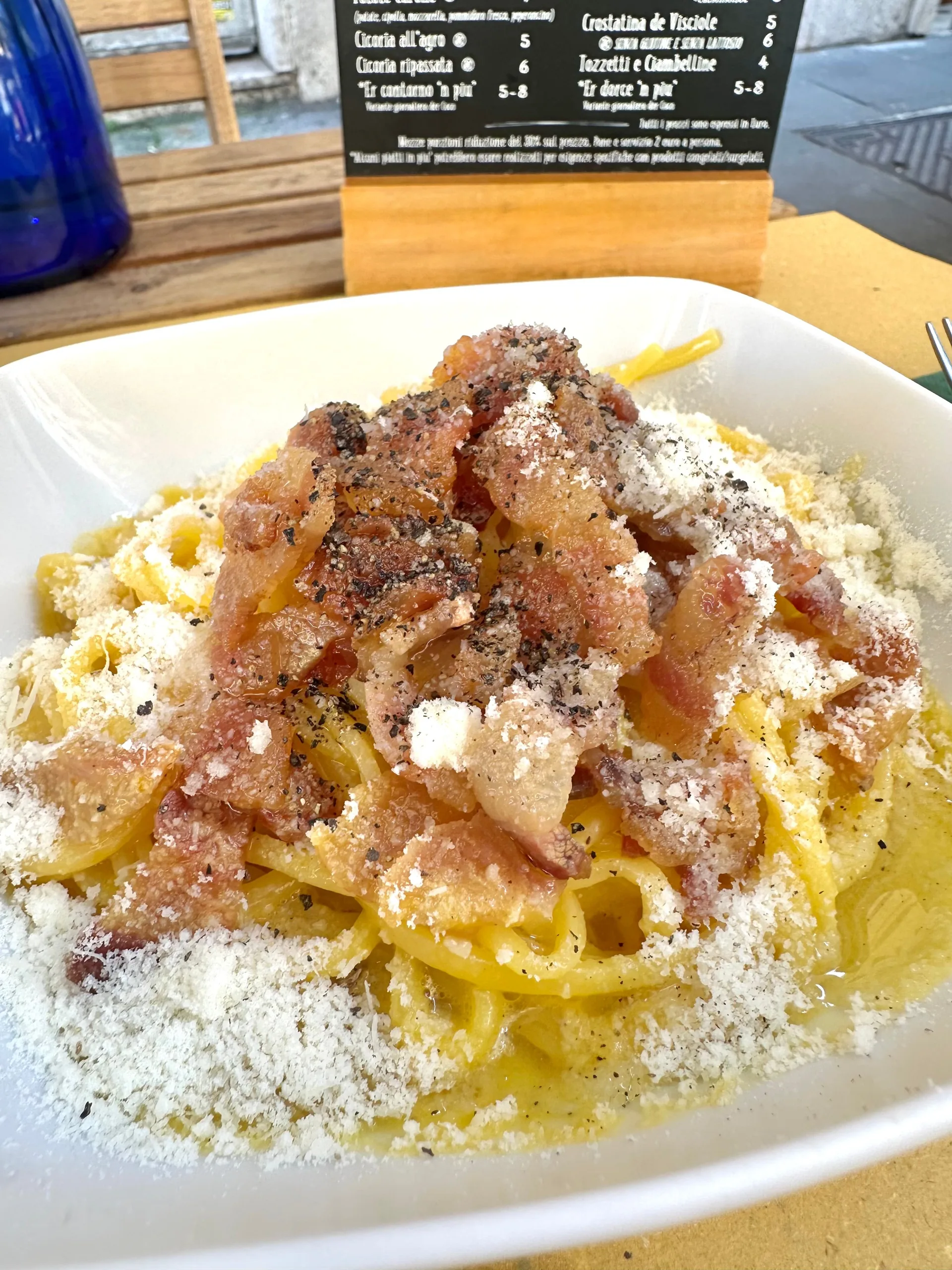
罗马第一面之王:意面、鸡蛋、酥脆猪颊肉与羊奶酪。一道必尝的奶香经典。
菜肴来源
罗马
原名
Carbonara
传统食谱原料
面食 - 猪颊肉 - Chicken eggs - 黑胡椒 - 佩克里诺芝士
禁用原料
奶油 - 大蒜 - 洋葱 - 橄榄油 - 黄油
使用这些原料被所有这道菜肴的爱好者认为是不可接受的错误。
可能含有的过敏原
麸质 - 鸡蛋
饮食风格 / 饮食禁忌
杂食哈拉姆(禁止)塔瑞夫(禁止)
规程
---
常见问题
Origins - Where does carbonara come from?
Pasta alla carbonara is one of the most famous dishes in Italian cuisine, but its origin is controversial and several theories have been advanced.
The most well-known theory is that it was born in Rome around the middle of the 20th century, created by charcoal workers who transported coal to the city.
According to this theory, the charcoal workers prepared this dish with the ingredients they had available, such as guanciale, pecorino romano and eggs. Guanciale was an economical ingredient and easy to find, while pecorino romano was a cheese typical of the Lazio region. Eggs were a precious ingredient, but the charcoal workers used them sparingly, beating the yolks with pecorino and black pepper and adding them to the pasta only at the end of cooking.
This theory is supported by a 1952 document, in which pasta alla carbonara is mentioned as a typical dish of Roman cuisine. However, some critics have argued that this document is not sufficient to prove the Roman origin of carbonara, since it could simply have been inspired by a similar dish that already existed.
Another highly credited hypothesis, perhaps the most well-known, is that carbonara was born during the time of the Allied occupation of Rome during World War II. American soldiers, with their rations of powdered eggs and bacon, would have inspired this recipe.
According to this theory, American soldiers would have combined powdered eggs, bacon and pecorino romano to create a dish similar to carbonara. This theory is supported by the fact that carbonara is a relatively simple dish that can be prepared with easily available ingredients.
There are also those who argue that carbonara is actually of Neapolitan origin, and that it only arrived in Rome later. According to this theory, pasta alla sfoglia would have been prepared with eggs, cheese and guanciale, and would have been brought to Rome by Neapolitans during their migration to the capital.
There is also the hypothesis of an even earlier origin, dating back to the 18th century and the cuisine of Papal Rome, where eggs, cheese and guanciale were often used in combination.
According to this theory, carbonara would have been born as a variant of "pasta alla gricia", a traditional dish of Lazio cuisine prepared with guanciale, pecorino romano and black pepper.
In short, there are various ideas about the birth of carbonara. But whatever its origin, today this dish has become one of the most beloved symbols of Italian cuisine in the world and in particular of the city of Rome, which has made it the quintessential iconic dish of the city.
原始食谱的食材有哪些?
制作卡尔博纳拉意面的经典食材包括:
意面
鸡蛋
罗马羊乳酪
猪颊肉
胡椒
粗盐
制作传统卡尔博纳拉意面通常使用以下几种面型:
细圆意面(Spaghetti)或粗圆意面(Spaghettoni):这是最具代表性的面型,也可能是卡尔博纳拉最初诞生时所用的面型。细长的意面与奶滑的酱汁完美融合。
半截管意面(Mezze maniche):有棱或无棱的半截管意面是细圆意面的良好替代品,能很好地挂住酱汁。
条纹管意面(Rigatoni):在短型意面中,条纹管意面是最佳选择,其形状有利于留住酱汁。
当然,卡尔博纳拉也可以用其他面型来制作,但传统上使用的就是以上这些。在罗马的餐厅里,也不乏使用Tonnarello的情况,这是拉齐奥版本的吉他面,一种新鲜的鸡蛋面,但纯粹主义者不太喜欢,认为这样菜里鸡蛋的比例太高了。
关于奶酪,也有几点需要说明。第一,一些厨师和食谱建议将罗马羊乳酪与帕尔马干酪混合使用,以降低羊乳酪的咸度。第二,需要注意所选用的罗马羊乳酪的类型,陈酿时间至少应达到12个月(法规规定的最低标准为8个月),并优先选用来自重量不太大的奶酪轮的羊乳酪。
卡尔博纳拉意面的制作步骤有哪些?
传统卡尔博纳拉意面的食谱要求将猪颊肉放入平底锅中煎炒几分钟,先用小火再转大火,利用其自身的油脂将其煎至酥脆。
另一个步骤是在碗中将鸡蛋与磨碎的罗马羊乳酪和少许胡椒混合搅打。民间关于鸡蛋用量的说法是:每位食客用一个整蛋加一个蛋黄,再额外加一个给锅。
与此同时,将意面放入加盐的沸水中煮熟,注意要等盐水完全沸腾后再下面。
将意面捞出,保留极嫩的口感,然后倒入盛有猪颊肉的平底锅中。
随后将打散的蛋液倒入平底锅,与意面、融化的奶酪和猪颊肉快速翻拌均匀,务必在关火状态下进行,以免炒成炒蛋,如有需要可缓慢加入少量煮面水以增加顺滑感。
重要的是,意面必须保持足够热度,才能使蛋液浓稠成奶油状而不被煮熟。
菜肴须立即上桌,最后撒上现磨胡椒和少许磨碎的罗马羊乳酪作为点缀。
What are the mistakes to avoid when cooking a Carbonara?
The catalog of mistakes made by those who prepare Carbonara is probably infinite if we look at nations outside of Italy, but these are certainly the most frequent ones that happen, unfortunately, even in Italy:
Overcooking the pasta. It should be drained very al dente, almost raw, to complete the cooking through tossing together with the sauce. The problem of overcooked pasta is one of the most frequent mistakes made by non-Italian cooks who often even throw the pasta into water that hasn't reached a boil yet.
Using pancetta or bacon instead of guanciale. Guanciale gives the dish much of its characteristic flavor and, while still being pork meat, it is not comparable to other fatty cuts that look very similar.
Adding cream, onion, or other non-traditional ingredients. While in many countries the use of cream in the recipe is certainly more widespread, greatly simplifying the creamy effect, cream completely changes, almost distorts, the flavor of the dish.
Not salting the pasta cooking water. The water must be well salted to season the pasta.
Omitting black pepper. Black pepper gives the characteristic peppery aftertaste.
Reaching too high temperatures. The egg mixture should never be brought to a boil or instead of a creamy sauce, we'll find bits of scrambled egg scattered throughout the dish.
Which wine pairs well with Carbonara?
Carbonara is a fantastic pasta dish but definitely not an easy choice when it comes to selecting the right wine pairing. In fact, all its ingredients have strong, distinctive flavors: the pasta with its soft taste, the guanciale with its creamy and enveloping consistency, the pecorino with its savory and bold taste, and the black pepper with its pungent notes.
To enhance this explosion of flavors and textures, the pairing requires a wine capable of balancing all its different nuances. First and foremost, it needs marked freshness and acidity to cleanse the palate from the fatty sensation of the guanciale. Then, good structure and intensity to stand up to the strong aroma of the pecorino. Finally, a pleasant alcoholic softness to temper the sharpness of the pepper.
Tradition calls for a white wine from Central Italy, to reflect the dish's region of origin. Excellent choices would therefore be whites such as Frascati, Greco di Tufo, Trebbiano d'Abruzzo, Pinot Grigio, and Vermentino. Alternatively, you could opt for vibrant Abruzzese rosés. Red wines that are too full-bodied or tannic should be avoided.
Are there any variants of Carbonara?
In Rome, it is possible to find some variants of Carbonara that essentially consist of adding an ingredient to the traditional recipe, mainly truffle, but also mushrooms.
There are then a series of other dishes for which the term carbonara is commonly used, but which actually have very little in common other than the use of egg in the dish.
Among these are carbonara di mare or carbonara di pesce, carbonara di zucchine, carbonara di asparagi, carbonara di carciofi, carbonara vegetariana or carbonara vegana.
How is carbonara prepared around the world?
Being arguably the most widespread pasta dish in the world, it's important to be aware that in many countries the recipes used are very different from the original, having adapted to local tastes and ingredients.
For example, in the United States it is frequently prepared with cream, grated cheese and pancetta or bacon instead of guanciale. It often also contains garlic, onion or other ingredients that are atypical for the Italian recipe.
In Great Britain and Ireland too, there is a tendency to use bacon and add cream or whole egg to the beaten eggs. In these versions carbonara turns out to be particularly creamy.
In France it is known as "carbonara alla francese", made with fresh cream, white wine and Parmigiano. Guanciale is absent and it is decidedly more delicate.
Carbonara in South America is seasoned with pork or chicken meat instead of guanciale. It is often enriched with tomato, peppers and other vegetables.
In Asian cuisines, ingredients such as soy sprouts, wok vegetables or shrimp are commonly added to carbonara.
In Japan, the version with zucchini, peas and shiitake mushrooms is popular and very often it is prepared completely without using eggs.
Each country has interpreted pasta alla carbonara in an original way, but taking considerable liberties with respect to the traditional Italian recipe. It is important to keep these differences in mind both for the tourist visiting Italy, who will probably experience a flavor different from what was expected, and for restaurateurs who might plan a more gradual approach to offer based on the actual knowledge of the dish.
Is there a world day for of Carbonara?
Of course. For years now, April 6th has been celebrated worldwide as Carbonara Day with special initiatives and the collaboration of thousands of restaurants that offer dedicated menus or promotions on the purchase of a Carbonara dish.
In which city can you eat the best carbonara in the world?
This is the hundred-million-dollar question and it probably doesn't even have a single definitive answer. What we can say for certain is that Rome and Lazio are the right places where you can find the strongest candidates for the final victory.
We, in our own small way, make an effort to taste them for you, in complete anonymity, to photograph them and review them without filters or bias. We hope the result of our work will be useful for you to enjoy excellent carbonara and perhaps avoid the so-called tourist trap restaurants.