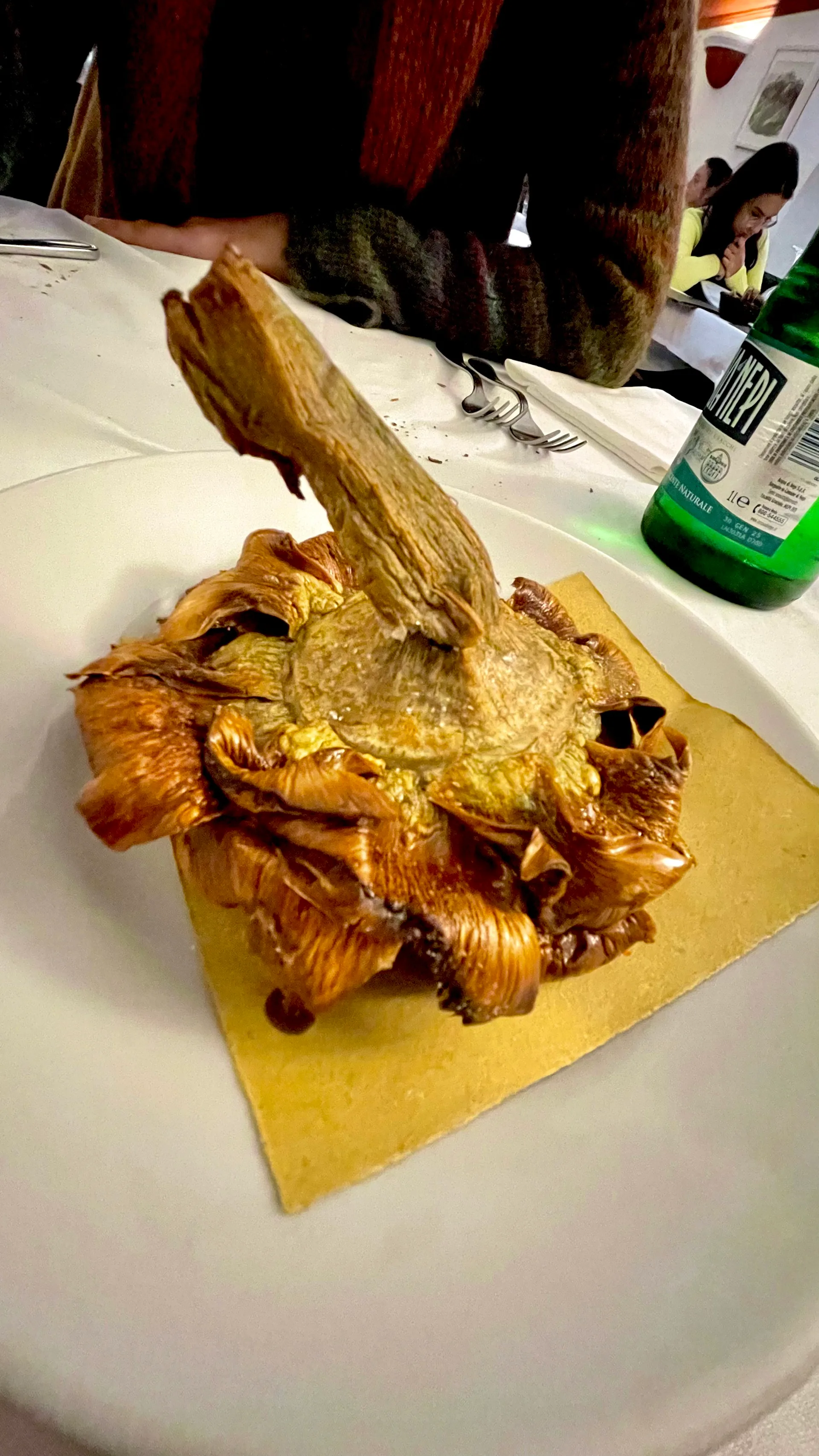
Description
A crispy flower from the Ghetto: a masterfully fried whole artichoke. Historic and irresistible.
Dish origin
Rome
Original italian name
Carciofo alla Giudia
Traditional recipe ingredients
Romanesco Artichoke - Olive Oil - Fine Salt
Optional ingredients
Pepper - Lemon Juice
Forbidden ingredients
Flour - Garlic - Vinegar
The use of these ingredients is considered an intolerable mistake by all lovers of this dish.
Dietary style / Precepts
OmnivoreHalalKosher
Official Recipe
---
Foodoso's guides to the best places to eat jewish-style artichoke
Frequently Asked Questions
What are the ingredients in the original recipe?
Just a few, precise ones: Roman artichoke, extra virgin olive oil, fine salt. Those who wish can add a bit of black pepper and a few drops of lemon to prevent oxidation during cleaning. Nothing else. The strength of Jewish-style artichoke lies precisely in this simplicity — no flour, no garlic, no vinegar.
Origin - Where does carciofo alla giudia come from?
It originates in the Jewish Ghetto of Rome, probably between the 16th and 17th centuries. Judeo-Roman cuisine has a very long tradition of frying in pure oil — without lard, to respect kosher rules — and jewish-style artichoke is perhaps the most well-known symbol of that gastronomic culture.
Is there a World Day dedicated to carciofo alla giudia?
There's no world day dedicated specifically to it as far as we know. There is a World Artichoke Day in a general sense. Let's say that in Rome there's no need for a date on the calendar to celebrate it.
In which city can you eat the best carciofo alla giudia in the world?
Rome, without question. And within Rome, the Ghetto. Outside this area — with that artichoke, that oil, those hands — it becomes something else.
What wine should you pair with a dish of Carciofo alla giudia?
Artichoke is notoriously difficult to pair with wine because cynarin slightly alters the perception of taste. That said, in our region we often go for fresh whites that aren't too structured: a Frascati Superiore DOC handles the bitter note well, as does an Est! Est!! Est!!! from Montefiascone. If you want to venture outside Lazio, a Verdicchio dei Castelli di Jesi can work for its saltiness. It's better to avoid tannic reds or oak-aged wines.
How do you make jewish-style artichoke at home in the authentic way?
Clean the Roman artichoke by removing the hard outer leaves and shape it into an almost spherical form, then beat it gently on the cutting board to open it slightly. Cooking happens in two phases: first fry at medium temperature until the heart is tender, then raise the heat and immerse it again to make the outer leaves open and brown. Salt, a little pepper, and serve.
How do you clean and prepare jewish-style artichoke before cooking?
You need to remove the hardest outer leaves — the dark green ones — until you reach the lighter and more tender leaves. The stem is peeled but left attached, because it's as delicious as the rest. Shape the artichoke with a small knife to give it a regular form, beat it gently on the work surface to open the leaves a bit, and then keep it in acidulated water, turning it with ice and lemon juice to prevent it from blackening while you work.
At what temperature and for how long do you fry a Jewish-style artichoke?
The first frying should be done around 150-160°C for about 10-12 minutes, until the artichoke is cooked through at the heart. Then drain it, open it a bit more with your fingers and dip it again in much hotter oil — around 180°C — for another 2-3 minutes, which makes the leaves open and become crispy like chips. The double frying is what distinguishes jewish-style artichoke from a simple fried artichoke.
What's the difference between jewish-style artichoke and regular fried artichoke?
The difference is substantial, not just aesthetic. A regular fried artichoke is often breaded or floured, cut into wedges or slices. jewish-style artichoke, instead, is fried whole, without batter, with the double immersion in oil that creates that characteristic flower-shaped form with crispy and golden outer leaves. And here, technique is everything.
What type of artichoke is used to prepare jewish-style artichoke: will any variety work?
No, any variety won't do. The Roman artichoke is used, also called mammola or cimarolo — round, compact, spineless, with a tender heart that holds up to the double frying without falling apart. Other varieties of artichoke, elongated, spiny or of other kinds give a completely different result. Out of season or outside of Lazio, finding it fresh is not always easy.
Where to eat authentic jewish-style artichoke in Rome: recommended neighborhoods and restaurants?
The place everyone will tell you about is the Jewish Ghetto, in the Portico d'Ottavia area. Here you'll find historic trattorias like Nonna Betta or Ba'Ghetto where jewish-style artichoke has been a staple for generations. Trastevere also has some valid addresses, but the heart of the tradition remains there, in the Ghetto, where this recipe was born.