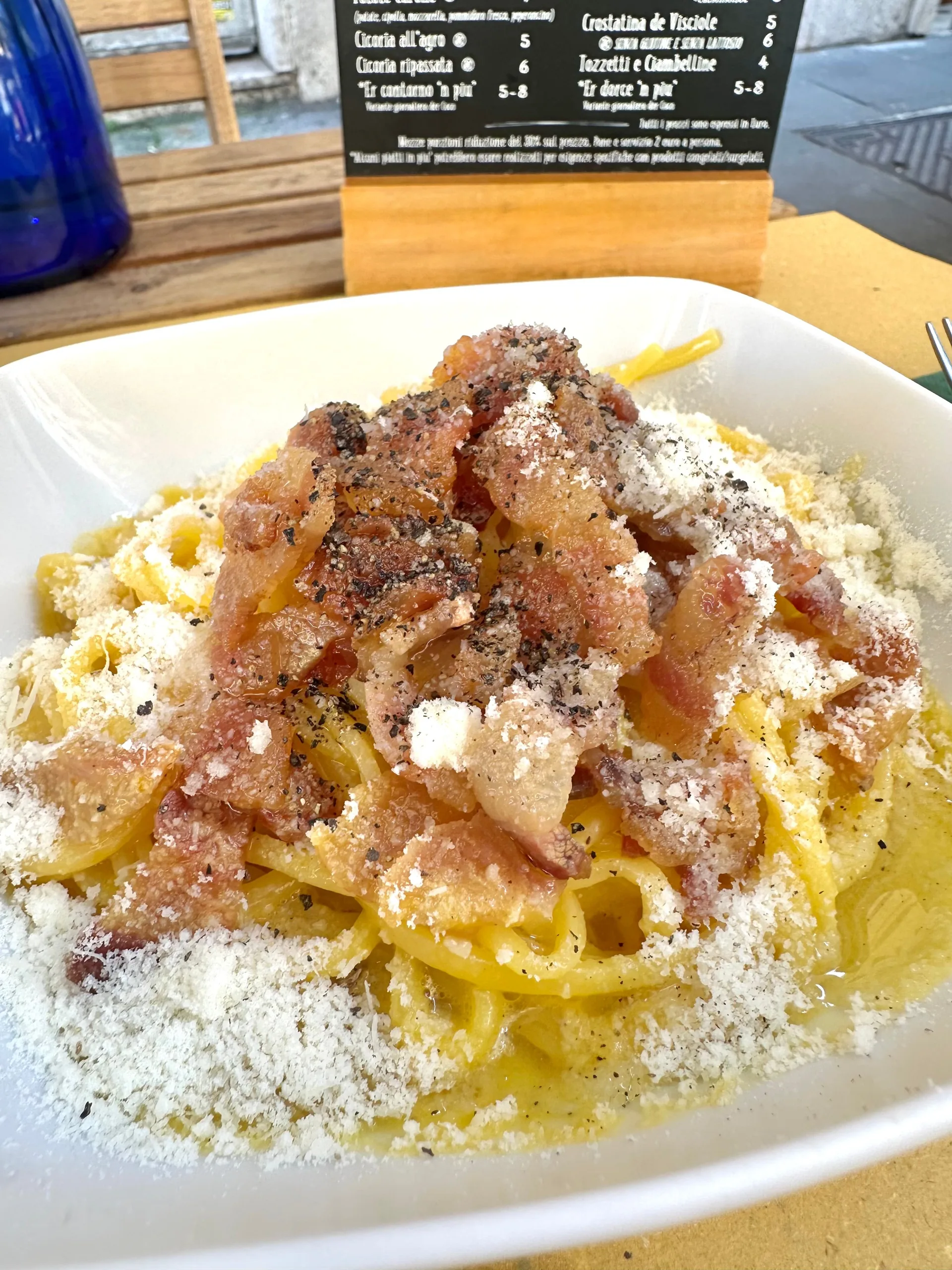
Description
The king of Roman pasta: eggs, crispy guanciale, and pecorino. A creamy legend and an absolute must-try
Dish origin
Rome
Original italian name
Carbonara
Traditional recipe ingredients
Pasta - Guanciale (pork jowl) - Chicken eggs - Pepper - Pecorino
Forbidden ingredients
Cream - Garlic - Onion - Olive Oil - Butter
The use of these ingredients is considered an intolerable mistake by all lovers of this dish.
Possible allergies
Gluten - Eggs
Dietary style / Precepts
OmnivoreHaramTaref
Official Recipe
---
Frequently Asked Questions
Origins - Where does carbonara come from?
Pasta alla carbonara is one of the most famous dishes in Italian cuisine, but its origin is controversial and several theories have been advanced.
The most well-known theory is that it was born in Rome around the middle of the 20th century, created by charcoal workers who transported coal to the city.
According to this theory, the charcoal workers prepared this dish with the ingredients they had available, such as guanciale, pecorino romano and eggs. Guanciale was an economical ingredient and easy to find, while pecorino romano was a cheese typical of the Lazio region. Eggs were a precious ingredient, but the charcoal workers used them sparingly, beating the yolks with pecorino and black pepper and adding them to the pasta only at the end of cooking.
This theory is supported by a 1952 document, in which pasta alla carbonara is mentioned as a typical dish of Roman cuisine. However, some critics have argued that this document is not sufficient to prove the Roman origin of carbonara, since it could simply have been inspired by a similar dish that already existed.
Another highly credited hypothesis, perhaps the most well-known, is that carbonara was born during the time of the Allied occupation of Rome during World War II. American soldiers, with their rations of powdered eggs and bacon, would have inspired this recipe.
According to this theory, American soldiers would have combined powdered eggs, bacon and pecorino romano to create a dish similar to carbonara. This theory is supported by the fact that carbonara is a relatively simple dish that can be prepared with easily available ingredients.
There are also those who argue that carbonara is actually of Neapolitan origin, and that it only arrived in Rome later. According to this theory, pasta alla sfoglia would have been prepared with eggs, cheese and guanciale, and would have been brought to Rome by Neapolitans during their migration to the capital.
There is also the hypothesis of an even earlier origin, dating back to the 18th century and the cuisine of Papal Rome, where eggs, cheese and guanciale were often used in combination.
According to this theory, carbonara would have been born as a variant of "pasta alla gricia", a traditional dish of Lazio cuisine prepared with guanciale, pecorino romano and black pepper.
In short, there are various ideas about the birth of carbonara. But whatever its origin, today this dish has become one of the most beloved symbols of Italian cuisine in the world and in particular of the city of Rome, which has made it the quintessential iconic dish of the city.
What are the ingredients of the original recipe?
The classic ingredients for preparing Carbonara are:
Pasta
Eggs
Pecorino romano
Guanciale
Black pepper
Coarse salt
For Carbonara, these pasta shapes are traditionally used:
Spaghetti or Spaghettoni: this is the most iconic format and probably the one with which Carbonara was born. Long, thin spaghetti pair perfectly with the creamy sauce.
Mezze maniche: ridged or smooth mezze maniche are a valid alternative to spaghetti, suitable for catching the sauce.
Rigatoni: rigatoni are the best choice among short pastas, thanks to their shape that holds the sauce.
Of course, Carbonara can be prepared with other pasta shapes, but the traditional ones remain these. In Roman restaurants, it is not uncommon to find Tonnarello being used, the Lazio version of spaghetto alla chitarra, a fresh egg pasta, though not favored by Carbonara purists due to this excess of egg in the dish.
As for cheese, some clarifications should be made. The first is that some chefs and recipes suggest using a mix of pecorino romano and Parmigiano Reggiano in order to soften the saltiness of pecorino. The second concerns the attention to pay to the type of pecorino romano to be used, which should have at least 12 months of aging, while the minimum according to regulations is 8 months, and it is preferable to choose pecorino derived from not overly large wheels.
What are the preparation steps for Carbonara?
The traditional recipe for pasta alla Carbonara involves browning, or sweating, the guanciale in a pan for a few minutes, first over low heat and then high heat, making it crispy by frying it in its own fat.
Another preparation step involves beating eggs with grated pecorino and a pinch of pepper in a bowl. Popular wisdom regarding the eggs to use suggests one whole egg plus one egg yolk per person, plus one extra for the pan.
Meanwhile, cook the pasta in salted water, making sure to bring the salted water to a boil before adding the pasta.
Once the pasta is drained very al dente, pour it into the pan with the guanciale.
The beaten egg mixture is then poured into the pan and combined with the pasta, melted cheese, and guanciale, mixing quickly to emulsify everything, strictly off the heat to avoid a scrambled egg effect, and slowly adding cooking water if necessary for the creaminess of the dish.
It is important that the pasta is hot enough to thicken the egg cream without cooking it.
The dish is served immediately, finishing with a grind of fresh pepper and grated pecorino on top.
What are the mistakes to avoid when cooking a Carbonara?
The catalog of mistakes made by those who prepare Carbonara is probably infinite if we look at nations outside of Italy, but these are certainly the most frequent ones that happen, unfortunately, even in Italy:
Overcooking the pasta. It should be drained very al dente, almost raw, to complete the cooking through tossing together with the sauce. The problem of overcooked pasta is one of the most frequent mistakes made by non-Italian cooks who often even throw the pasta into water that hasn't reached a boil yet.
Using pancetta or bacon instead of guanciale. Guanciale gives the dish much of its characteristic flavor and, while still being pork meat, it is not comparable to other fatty cuts that look very similar.
Adding cream, onion, or other non-traditional ingredients. While in many countries the use of cream in the recipe is certainly more widespread, greatly simplifying the creamy effect, cream completely changes, almost distorts, the flavor of the dish.
Not salting the pasta cooking water. The water must be well salted to season the pasta.
Omitting black pepper. Black pepper gives the characteristic peppery aftertaste.
Reaching too high temperatures. The egg mixture should never be brought to a boil or instead of a creamy sauce, we'll find bits of scrambled egg scattered throughout the dish.
Which wine pairs well with Carbonara?
Carbonara is a fantastic pasta dish but definitely not an easy choice when it comes to selecting the right wine pairing. In fact, all its ingredients have strong, distinctive flavors: the pasta with its soft taste, the guanciale with its creamy and enveloping consistency, the pecorino with its savory and bold taste, and the black pepper with its pungent notes.
To enhance this explosion of flavors and textures, the pairing requires a wine capable of balancing all its different nuances. First and foremost, it needs marked freshness and acidity to cleanse the palate from the fatty sensation of the guanciale. Then, good structure and intensity to stand up to the strong aroma of the pecorino. Finally, a pleasant alcoholic softness to temper the sharpness of the pepper.
Tradition calls for a white wine from Central Italy, to reflect the dish's region of origin. Excellent choices would therefore be whites such as Frascati, Greco di Tufo, Trebbiano d'Abruzzo, Pinot Grigio, and Vermentino. Alternatively, you could opt for vibrant Abruzzese rosés. Red wines that are too full-bodied or tannic should be avoided.
Are there any variants of Carbonara?
In Rome, it is possible to find some variants of Carbonara that essentially consist of adding an ingredient to the traditional recipe, mainly truffle, but also mushrooms.
There are then a series of other dishes for which the term carbonara is commonly used, but which actually have very little in common other than the use of egg in the dish.
Among these are carbonara di mare or carbonara di pesce, carbonara di zucchine, carbonara di asparagi, carbonara di carciofi, carbonara vegetariana or carbonara vegana.
How is carbonara prepared around the world?
Being arguably the most widespread pasta dish in the world, it's important to be aware that in many countries the recipes used are very different from the original, having adapted to local tastes and ingredients.
For example, in the United States it is frequently prepared with cream, grated cheese and pancetta or bacon instead of guanciale. It often also contains garlic, onion or other ingredients that are atypical for the Italian recipe.
In Great Britain and Ireland too, there is a tendency to use bacon and add cream or whole egg to the beaten eggs. In these versions carbonara turns out to be particularly creamy.
In France it is known as "carbonara alla francese", made with fresh cream, white wine and Parmigiano. Guanciale is absent and it is decidedly more delicate.
Carbonara in South America is seasoned with pork or chicken meat instead of guanciale. It is often enriched with tomato, peppers and other vegetables.
In Asian cuisines, ingredients such as soy sprouts, wok vegetables or shrimp are commonly added to carbonara.
In Japan, the version with zucchini, peas and shiitake mushrooms is popular and very often it is prepared completely without using eggs.
Each country has interpreted pasta alla carbonara in an original way, but taking considerable liberties with respect to the traditional Italian recipe. It is important to keep these differences in mind both for the tourist visiting Italy, who will probably experience a flavor different from what was expected, and for restaurateurs who might plan a more gradual approach to offer based on the actual knowledge of the dish.
Is there a world day for of Carbonara?
Of course. For years now, April 6th has been celebrated worldwide as Carbonara Day with special initiatives and the collaboration of thousands of restaurants that offer dedicated menus or promotions on the purchase of a Carbonara dish.
In which city can you eat the best carbonara in the world?
This is the hundred-million-dollar question and it probably doesn't even have a single definitive answer. What we can say for certain is that Rome and Lazio are the right places where you can find the strongest candidates for the final victory.
We, in our own small way, make an effort to taste them for you, in complete anonymity, to photograph them and review them without filters or bias. We hope the result of our work will be useful for you to enjoy excellent carbonara and perhaps avoid the so-called tourist trap restaurants.